Part 2: Beyond Soft Pastels
How I Use Medium & Hard Pastels & Pastel Pencils
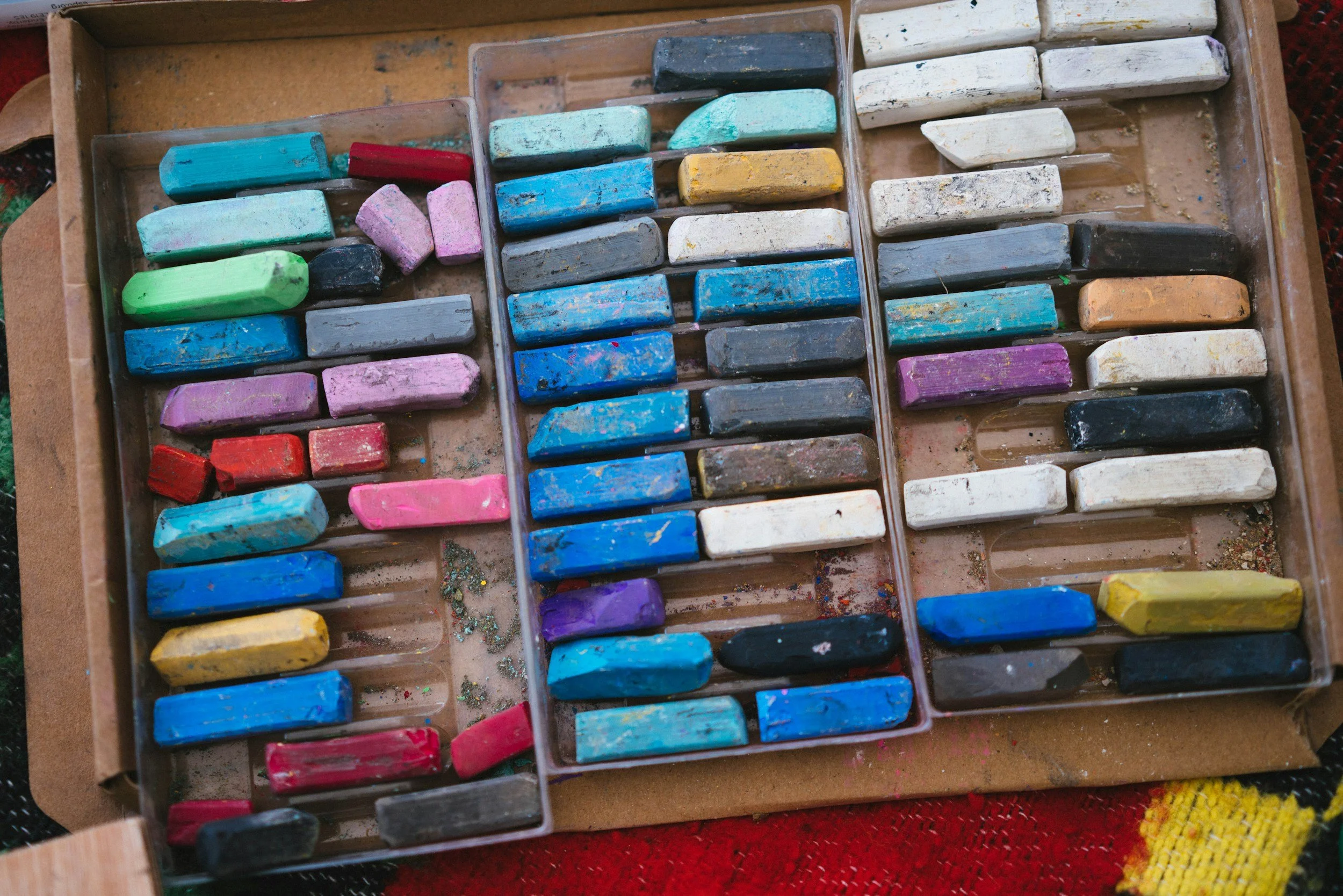
When I see an image of pastels like this, I tend to think of hard pastels. Hard pastels are more difficult to apply to the paper, which is a good way to remember the difference between hard and soft pastels. Soft pastels cover the surface more quickly and fill the tooth of the paper faster. Image courtesy of Unsplash.
Types of Pastels
Selecting which type of pastel to use can be very confusing. There are different levels of hardness and softness, along with countless brands to choose from. My goal in writing this two-part series is to clarify what I have learned over my three-year journey of learning to use pastels.
In Part 1, I focused exclusively on soft pastels, so be sure to check that out if you would like to learn more about them. In that blog, I covered the properties of soft pastels, how I use them in my work, key takeaways, mark-making guides, and links to specific brands that I love. If you purchase any supplies by using one of my links, it helps to support me in writing this blog. Here is the link to Part 1:
In Part 2, I’ll go over how I use medium and hard pastels when creating realistic artwork. There are no hard-and-fast rules about what you can use and when, but I have found that certain types of pastels work better for specific techniques and stages of the process. I’ll also share which brands I personally prefer. That said, please share in the comments if you think I am overlooking a particular brand. I am always willing to try a new art supply!
Medium Pastels
What Are Medium Pastels?
I’m going to reference Dakota Pastel’s PDF sheet again in this blog because I think it’s so helpful. It ranks the major brands of pastels as a range from soft to hard. Here is the link to that: Dakota Ranking Sheet
Dakota ranks three brands as having “medium” softness: Rembrandt, Art Spectrum, and Holbein.
Medium pastels are the bridge between soft and hard pastels. They contain more binder than soft pastels but less than hard pastels, giving them a balance of color intensity, durability, and control. They are less powdery and crumbly than soft pastels, but they still release rich color with relatively little pressure. Because they contain more binder, they don't fill the tooth of the paper as quickly, allowing you to build more layers before reaching the surface's limit. As pastel hardness increases, however, you do give up a bit of color intensity and vibrancy.
Suggested Medium Pastel Brands
The only medium pastels I own from Dakota's list are Rembrandt. I bought several of the small sets from Michaels when they were on sale. That doesn’t mean that the other brands are bad; I just haven’t tried them yet.
The sets I bought were the Rembrandt Soft Pastel Micro Sets, which contain 10 half-sticks. At the time of writing (July 1, 2026), they're around $15 on Amazon, but I picked mine up for about $5 each. Michaels had several different color assortments, and I scooped up a few boxes while they were discounted.
If you're looking for a larger starter set, the Rembrandt Soft Pastels General Selection Deluxe Set (60 half sticks) offers an excellent range of colors and is typically around $60.
When I Use Medium Pastels
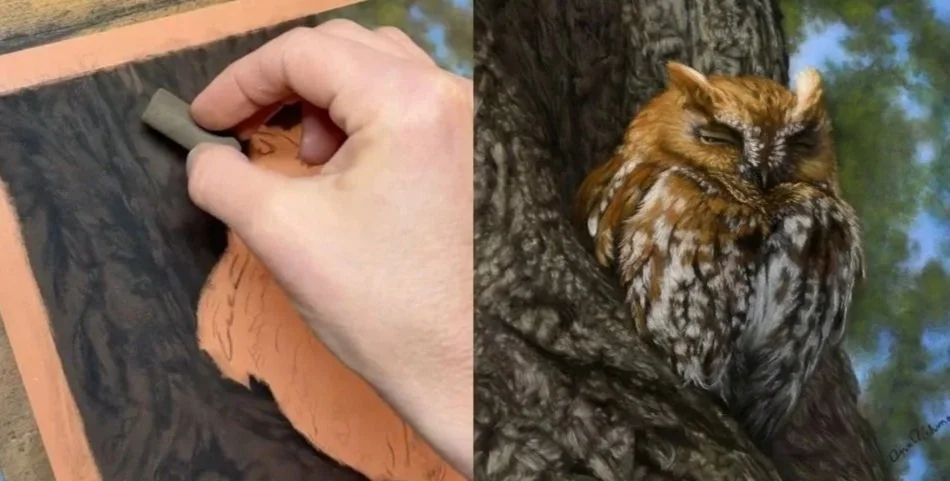
I leaned heavily on my Rembrandts to create the texture of the bark Between Flights. On the left, I am using a greenish Rembrandt pastel to block in layers of bark. On the right is the finished scan of the artwork.
I don't reach for medium pastels nearly as often as soft pastels (which is why I don’t own many), but there are a few situations where they really shine.
The first is when I don't want to fill the tooth of the paper too quickly. This is especially helpful when I'm laying down base layers or experimenting before committing to the final painting. That was the case when I created Between Flights, shown above. Bark is tricky, and I knew I might have to experiment a bit before I figured out the right colors and marks to capture its texture. Because of that, I didn't want to jump straight to soft pastels. If my first attempts didn't work, I could have filled the tooth of the paper before I found the look I was after.
The second time I reach for medium pastels is when I find a color I need but don't own in a soft pastel. That also happened in Between Flights. I have a small Rembrandt set of darks and dark greens that contained exactly the colors I needed for this painting, so it made perfect sense to use them.
Finally, there are times when I intentionally don't want the full intensity of a soft pastel. That was true for this piece as well. I wanted the tree bark to support the composition without competing with the star of the painting, the eastern screech owl. Because medium pastels contain more binder, they are slightly less vibrant than soft pastels. The difference isn't dramatic, but sometimes that subtle reduction in intensity is exactly what a painting needs.
Key Takeaways
Medium pastels contain more binder than soft pastels but less than hard pastels, giving them an excellent balance of color and control.
They don't fill the tooth of the paper as quickly, making them ideal for base layers and experimentation.
They are a great option when you need a specific color that isn't available in your soft pastel collection.
Their slightly reduced vibrancy can actually be an advantage when you want supporting areas to remain subordinate to your focal point.
They excel at creating controlled texture, making them particularly useful for backgrounds, bark, grass, and other natural surfaces.
My go-to medium pastel brand is Rembrandt, which offers excellent quality at a reasonable price.
Mark Making Guide
Medium pastels hold their edges longer than soft pastels, giving you a little more control while still producing a variety of marks. They work especially well for:
Blocking in base layers without filling the tooth of the paper too quickly.
Textured backgrounds, where you want a variety of broken marks without overwhelming the focal point.
Tree bark, because the slightly firmer stick makes it easier to create irregular cracks, ridges, and directional strokes.
Fur and feathers, particularly the early layers, where you want to suggest texture before refining it with softer pastels or pastel pencils.
Edges and transitions, when you need a little more precision than a soft pastel can provide.
Hard Pastels
What Are Hard Pastels?
Hard pastels are the firmest of the traditional pastel sticks. They contain more binder and less pigment than both soft and medium pastels, making them significantly harder and less powdery. Because they release less pigment with each stroke, they don't fill the tooth of the paper as quickly and can produce crisp, controlled marks that would be difficult to achieve with a soft pastel.
The tradeoff is color intensity. As pastel hardness increases, vibrancy decreases. Hard pastels generally aren't the best choice when you want rich, saturated color, but they excel when control and precision are more important than maximum pigment.
When I Use Hard Pastels
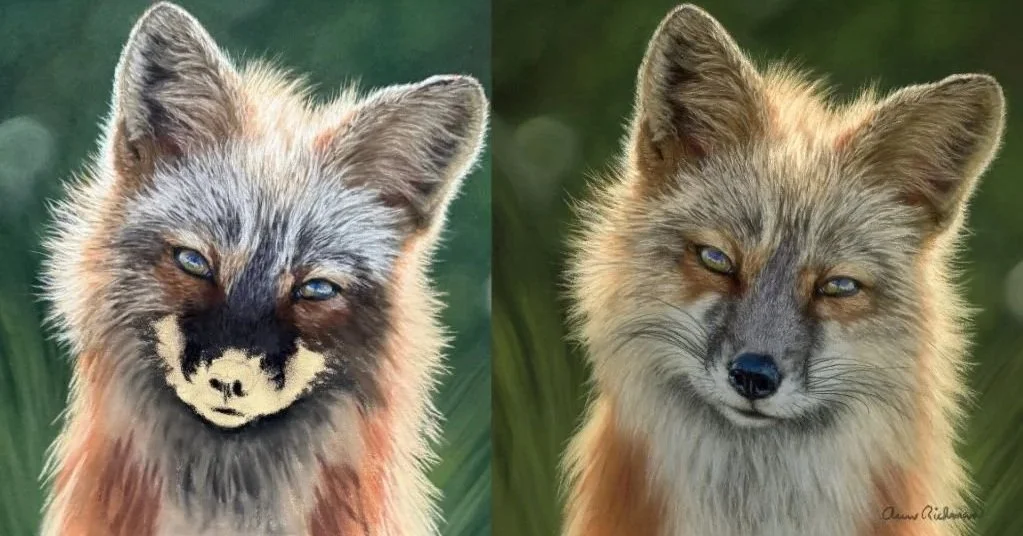
Work in progress on Halo, on the left, and the final scan on the right. I always begin a painting by blocking in the darkest values and gradually building lighter values on top. For this piece, I used a black Prismacolor NuPastel hard pastel to establish the deepest shadows in the early layers.
Although I rely on soft pastels for most of my paintings, there are several situations where hard pastels become indispensable.
The first is blocking in dark areas, especially black. See an example of how I do this in Halo above. You can see where I put in very dark layers on the nose as an initial stage. My favorite hard pastel for this is the Prismacolor NuPastel black. This brand of black lays down beautifully without filling the tooth too quickly, giving me a solid foundation for building darker passages later. It is the richest and deepest black I’ve been able to find. If you know of something better, please let me know in the comments!
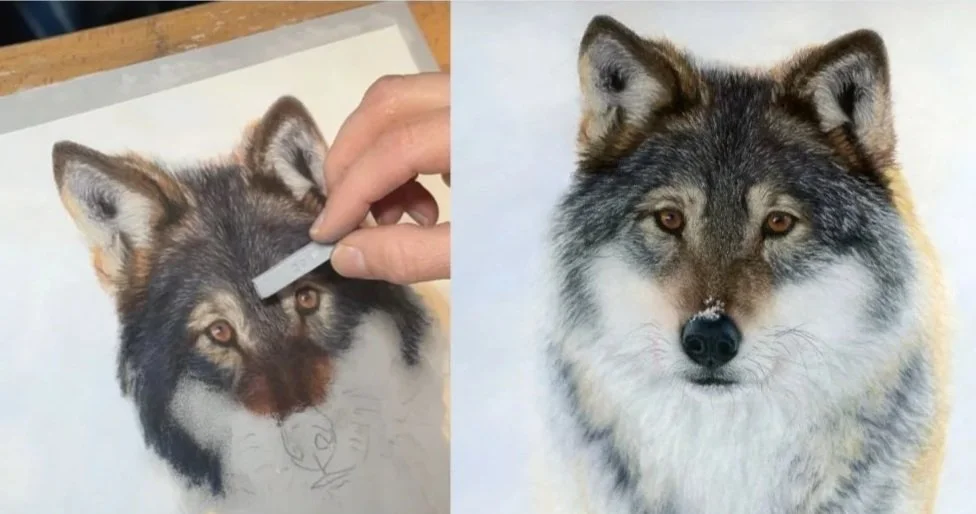
I used a light gray NuPastel to create the illusion of lighter fur over the wolf's darker coat in "Where the Wolf Becomes Winter." A close-up of the finished painting is shown on the right.
In Where the Wolf Becomes Winter, shown above, I used a light gray Prismacolor NuPastel to render the fine hairs around the wolf's face. The soft pastels were too soft and deposited too much light pigment, while the pastel pencils didn't lay down enough color to create convincing individual hairs. The hard pastel turned out to be the perfect solution. It provided enough pigment and contrast while still allowing me to draw the thin, controlled lines needed to suggest the fur's texture.
I also reach for hard pastels when I need a color I don't have in soft pastel. While they aren't as vibrant, sometimes having the right hue is more important than maximum saturation. That's another reason I like the larger NuPastel sets. They include a wonderful variety of colors, so I can usually find the hue I'm looking for.
Finally, I reach for hard pastels when I need to create fine, controlled lines. Their firm edges allow me to make much smaller marks than I can with a soft pastel, making them useful for fur, feathers, branches, and grasses, and other areas where precision matters.
Suggested Hard Pastel Brands
Hard pastels are probably the type of soft pastels that I use the least. But whenever I use them, the two hard pastel brands I use most often are Prismacolor NuPastels and Cretacolor Hard Pastels.
Prismacolor NuPastels are my favorite by a wide margin. They're widely available, reasonably priced, and have an excellent range of colors. As I mentioned earlier, the black NuPastel is hard to beat.
That said, a second place as an option for black is this Cretacolor Artist Black Pencil, although it's currently around $8, which is pretty pricey for a single pencil. You may be able to find it for less from another retailer. Of all the black pencils I've tried, it's the closest I've found to the NuPastel in richness and coverage.
One word of caution: I find it can be difficult to sharpen. I use a Swordfish sharpener, and sometimes it produces a beautiful point, while other times it chews up the pencil instead. It's not a deal-breaker, but it's something to be aware of before you buy one.
If you're looking for a starter set of NuPastels, the 36-piece set is a great place to begin. Prismacolor no longer offers a 12-piece set. I personally own the 96-piece set, and I think it's an excellent value for the wide range of colors you get.
I also own the 12-piece set of Cretacolor Hard Pastels. They perform well and are another excellent option if you're looking for a harder pastel with good control. I don’t think they lay down as smoothly as the NuPastels, but that might be something you prefer.
Popular sets include:
Key Takeaways
Hard pastels contain the most binder and the least pigment of the traditional pastel sticks.
They produce less vibrant color, but offer much greater control.
They are excellent for sketching, blocking in values, and creating fine detail.
They fill the tooth of the paper more slowly than soft or medium pastels.
My favorite hard pastel is the Prismacolor NuPastel, especially the black stick! If you know of a black market dealer who sells black sticks, please let me know.
Hard pastels aren't a replacement for soft pastels, but they're an invaluable tool when precision matters.
Mark-Making Guide
Hard pastels excel when you want control over your marks.
They work especially well for:
Sketching the composition before beginning a painting.
Blocking in dark values, especially large black areas.
Drawing fine lines that would be difficult with a soft pastel.
Tree branches, grasses, whiskers, and feathers, where crisp marks are important.
Small details that require precision.
Layering early in a painting without quickly filling the tooth of the paper.
Pastel Pencils
What are Pastel Pencils?
Pastel pencils combine the blendable qualities of pastel with the precision of a pencil. Instead of a graphite or colored pencil core, they contain a firm pastel core encased in wood. Like pastel sticks, the core is made of pigment and a binder, but it contains more binder than soft, medium, or hard pastels do. This makes pastel pencils much firmer, allowing them to hold a sharp point for detailed work.
Because they contain more binder, pastel pencils don't release as much pigment with each stroke as pastel sticks. They are less vibrant than soft pastels and won't cover large areas efficiently, but they excel at creating fine lines, crisp edges, and intricate details. They also produce very little dust compared to soft pastels and slowly fill the tooth of the paper, making them ideal for the final stages of a painting.
Although they can certainly be used on their own, most pastel artists use them alongside pastel sticks. They are the perfect tool for adding the finishing touches that would be difficult or impossible to achieve with a larger pastel stick.
When I Use Pastel Pencils
In my early days of learning pastel, I painted almost exclusively with pastel pencils and PanPastels. They felt less intimidating than pastel sticks and gave me the control I was used to from working with colored pencils. As my confidence grew, I gradually shifted to using soft pastels for most of the painting process.
Today, I primarily use pastel pencils during the finishing stages of a painting. They simply don't release enough pigment to efficiently cover large areas, so I would never use them for early layers. If I tried, I'd be there forever! Instead, I let the pastel sticks do the heavy lifting and save the pastel pencils for refining and polishing the piece.
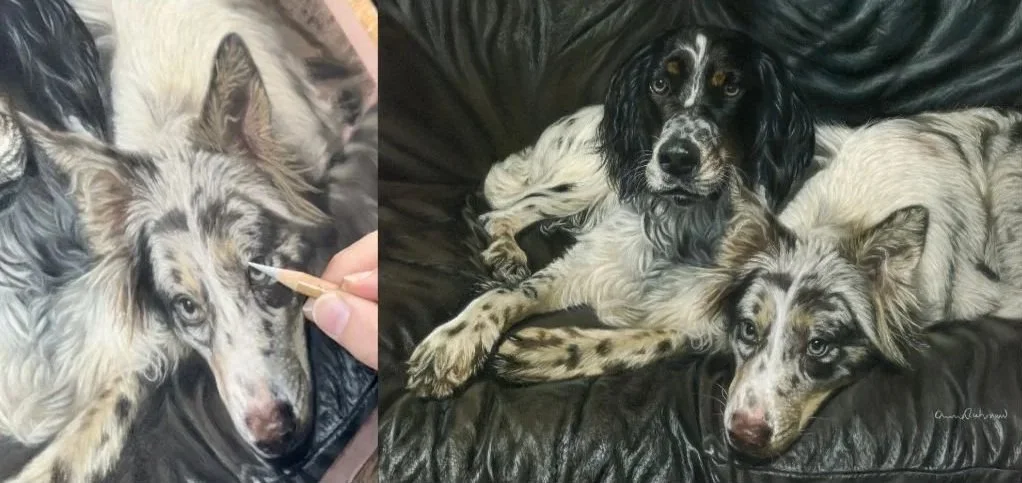
On the left, I'm pulling pigment from previously applied soft pastel with a pastel pencil. This technique allows me to create finer lines and more realistic fur than I could achieve with a soft pastel stick alone. The completed portrait of Remy and Cyrus is shown on the right.
One of the ways I use pastel pencils most often is to pull pigment from the soft pastels I've already applied. Rather than drawing with the pencil alone, I use it to drag and shape existing pastel, refining edges, defining forms, and creating more intentional marks. This technique allows me to achieve details that would be difficult with a pastel stick alone.
For example, in Remi and Cyrus, pictured above, I used a pastel pencil to pull the soft pastel outward into individual strands of fur. Instead of drawing every hair from scratch, the pencil dragged pigment that was already on the paper, creating natural-looking fur while preserving the darker hue of the soft pastel beneath.
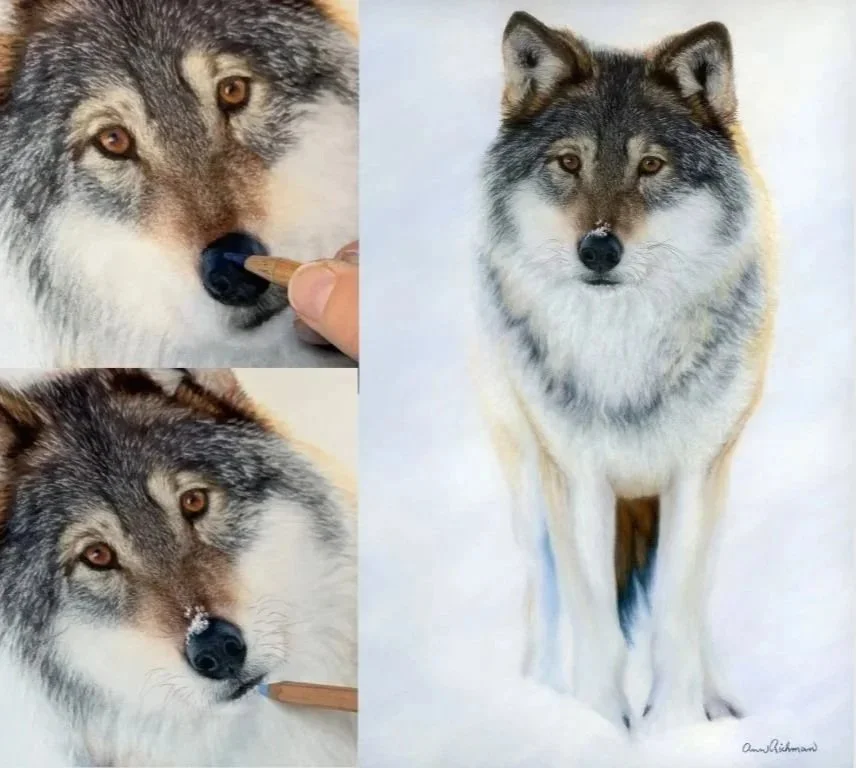
Above are two examples of how I use pastel pencils while creating Where the Wolf Becomes Winter. In the top left image, I am fine-tuning the nose by adding bright blue using a Pitt pencil. In the bottom left image, I am glazing the bottom lip with a Caran d’Ache blue pencil. If I used a soft pastel stick in either situation, the look would be too overpowering.
I also use pastel pencils to clean up areas where soft pastels have become a little messy. If a soft pastel leaves an edge that's thicker or softer than I'd like, I'll use a darker pastel pencil to color around it, sharpening the line and making the shape appear much cleaner.
A good example is Where the Winter Becomes the Wolf. After blocking in the wolf's nose with soft pastels, I used a pastel pencil to refine its edges and increase the contrast around the nostrils. Those small adjustments helped define the form and gave the nose a much cleaner, more realistic appearance.
Of course, pastel pencils excel at creating fine lines and tiny details. I rely on them around the eyes, nose, and mouth, where precision is critical. They are also wonderful for suggesting individual strands of fur, whiskers, and other delicate textures that would be difficult to create with a larger pastel stick.
Another reason I reach for pastel pencils is when I don't want the full intensity of a soft pastel. Of all the pastel forms, pastel pencils generally produce the least saturated color. Sometimes that softer application is exactly what I need to keep an area from competing with the focal point of the painting.
Finally, I almost always use a pastel pencil to create my initial line drawing. Their light, controlled marks are easy to cover with subsequent layers, making them an excellent tool for establishing the composition before I begin painting.
I think of pastel pencils as the finishing tool in my pastel toolbox. They don't replace pastel sticks, but they allow me to add the refinement, precision, and subtle details that bring a painting to life.
Suggested Pastel Pencil Brands
There are quite a few excellent pastel pencil brands on the market, and honestly, I don't think you can go terribly wrong with any of the major manufacturers. I own pencils from several brands because each has strengths.
My favorite pastel pencils are Caran d'Ache Pastel Pencils. They are buttery smooth and come in beautiful colors. The biggest downside is the price. I don't own a full set, only a handful of individual pencils in the colors I use most often. That said, I wish I owned the entire collection!
Another drawback is that they can be difficult to sharpen. I don't even bother using a traditional pencil sharpener because the cores are so soft that they tend to break. Instead, I use a box cutter or X-Acto knife to carefully expose the core and shape it into a point. It takes a little more time, but I get much better results.
The go-to pencils I use the most are Faber-Castell Pitt Pastel Pencils. They are a little firmer than the Caran d'Ache pencils, making them excellent for crisp details and controlled line work. They also tend to be more affordable and sharpen to a nice point using the Swordfish pencil sharpener (as long as you keep a sharp blade!).
Another popular option is Stabilo CarbOthello. Many pastel artists love them because they are softer than most pastel pencils and produce rich color while still allowing for fine detail. I enjoy Stabilos, but don’t use them as much as Pitts because I can’t sharpen them with the Swordfish. They break unless the blade is very sharp, for me anyway.
For beginners, I recommend purchasing a smaller set and gradually adding individual pencils in the colors you use most often. You can also buy single pencils if you want to try one or two of a brand before committing. I’d look to Blick Art in the US for buying single pencils. They have reasonable prices on art supplies and great customer service.
Key Takeaways
Pastel pencils contain a firm pastel core inside a wooden barrel; some brands are softer than others.
They release much less pigment than pastel sticks, making them ideal for detail work rather than covering large areas.
I use them almost exclusively during the finishing stages of a painting.
One of my favorite techniques is using a pastel pencil to shape and pull pigment from soft pastel that is already on the paper, rather than simply drawing with the pencil itself.
They are excellent for refining edges, cleaning up shapes, and adding fine details such as fur, whiskers, feathers, and facial features.
Because they are less saturated than pastel sticks, they are useful when you want a more subtle application of color.
I also use pastel pencils to create my initial sketch because their light marks are easy to cover as the painting develops.
Mark Making Guide
Pastel pencils are the most precise drawing tool in the pastel family.
They work especially well for:
Creating the initial line drawing before beginning a painting.
Refining edges and cleaning up shapes.
Pulling soft pastel into fine strands of fur or feathers.
Adding whiskers, eyelashes, grasses, and other delicate lines.
Rendering details around the eyes, nose, mouth, and ears.
Creating subtle texture without overwhelming an area with pigment.
Darkening around edges to sharpen forms and increase contrast.
Making finishing touches after the pastel sticks have done the majority of the work.
Conclusion
After reading this blog and my previous one on soft pastels, you may have noticed a common theme. No single type of pastel is "best." Each has its own strengths, and the real magic happens when you learn to use them together. Soft pastels provide the rich, vibrant color that forms the backbone of most of my paintings. Medium and hard pastels give me greater control when blocking in layers, creating texture, or finding just the right hue. Pastel pencils allow me to refine, sharpen, and add the finishing details that bring a painting to life.
If you're just getting started, don't feel like you need every brand or every type of pastel all at once. Begin with a good collection of soft pastels and gradually add a few medium pastels, hard pastels, and pastel pencils as your skills develop. Over time, you'll discover which tools best suit your own style and process. Hopefully, this series has given you a clearer understanding of how each type of pastel fits into the bigger picture and helps you build a collection that works for you.